Waterproofing in Kathmandu: The Complete Guide to Fixing Leaks for Good
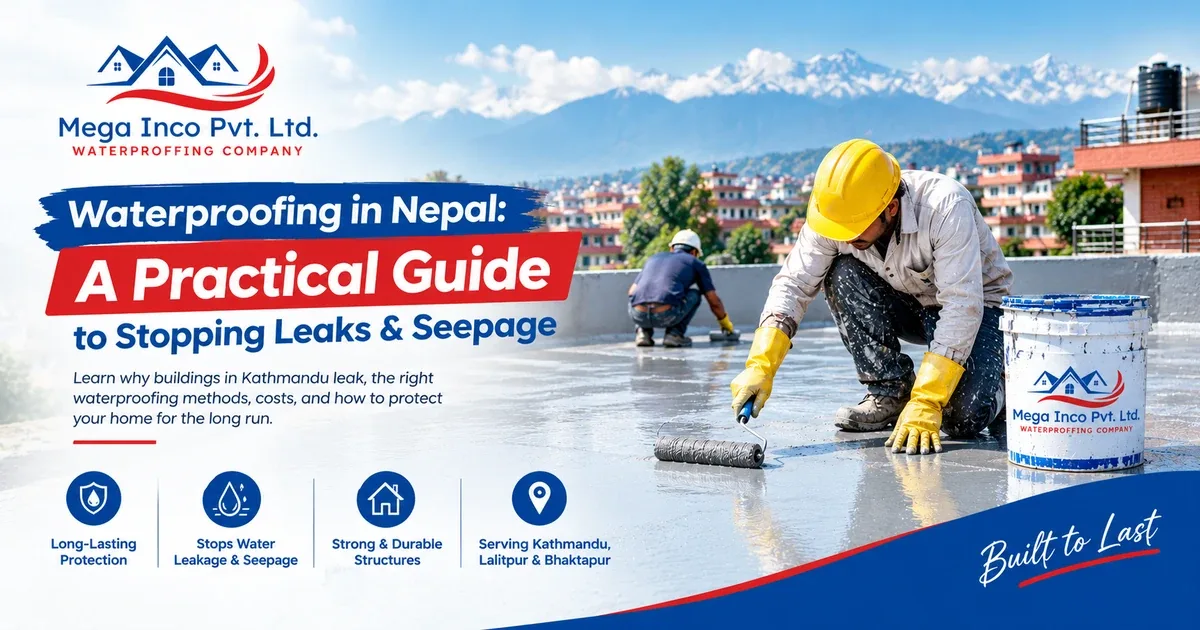
If you live in Kathmandu, you probably know the feeling. The first heavy monsoon rain comes, and a few days later a damp patch appears on the ceiling. You repaint it. Next year it comes back, bigger.
We have been dealing with exactly this since 2013, and the pattern is almost always the same: the leak was small, it was ignored or patched cheaply, and the repair eventually cost much more. This guide explains why buildings here leak, what actually fixes the problem, and how to avoid paying twice.
The short answer: There is no single best waterproofing method. The right fix depends on where the water is coming in and why. Roofs and terraces usually need a coating or membrane system, bathrooms need sealed joints and a tested floor, and basements and tanks need protection against constant moisture. Whatever the method, the surface must be prepared properly first, and the finished work should be tested with water. The dry season is the best time to do it.
Why do buildings in Kathmandu leak?
Most of the year’s rain falls between June and September, so roofs and walls get soaked again and again for months. Over time, that finds every weak spot. These are the causes we see most:
- Hairline cracks in the concrete slab that widen with temperature changes
- Terraces that don’t slope properly, so water sits and seeps in
- Old paint or thin coatings that have worn away in the sun and rain
- Weak joints where walls meet slabs, or around pipes and water tank stands
- Bathroom floors where water gets through tile joints and corners
- Buildings that were finished without any waterproofing layer at all
Which waterproofing methods work in Nepal?
Here is how the main methods are used, in plain terms:
- PP/PE membrane: A multi-layer sheet that creates a continuous barrier. Common on terraces, flat roofs, and areas that will be tiled over.
- Polymer coating: A polymer-modified cement layer that bonds to concrete. Used on roofs, bathrooms, basements, and foundation walls.
- Acrylic roof coating (Roofseal): A flexible, UV-resistant layer for exposed roofs.
- Cement grouting: Fills cracks and seepage points, and seals around pipes.
- Epoxy injection and micro-concrete: Used for structural cracks, holes, and heavy-duty repair.
- Bitumen sheet systems: Heat-applied layers, common on large flat roofs.
A good contractor won’t push one product for every job. They will look at your building first. You can see how we use each method on our services page.
How is waterproofing done properly?
Here is the process we follow, and what you should expect from any contractor:
- Inspect the site. Find where the water really enters. The stain is often not directly below the leak.
- Prepare the surface. Chip off loose material, clean away dust and grease, and shape the corners and edges so the layer bonds well.
- Repair cracks and joints. Seal these before the main layer goes on.
- Apply the primer or polymer coating. Usually two coats.
- Install the coating or membrane. Follow the manufacturer’s instructions.
- Do a water test. Fill the area with water and watch for leaks before anything is covered. This often runs for one to three days.
- Add the protective finish once the test passes.
If a contractor skips the water test, ask why. It is the cheapest way to catch a mistake while it is still easy to fix.
How much does waterproofing cost in Nepal?
It varies a lot, because waterproofing is not one product. The main things that change the cost are:
- Area: Large surfaces are usually priced by area, while details like pipes and corners are priced by point.
- Method and material: Coatings, membranes, and epoxy repairs differ in both materials and labour.
- Surface condition: An old, cracked, or dirty slab needs far more preparation.
- Access: Hard-to-reach areas take more time.
- Scope: Fixing a current leak is different from waterproofing a new slab.
Because every building is different, a fair quote needs a site visit. We offer free inspections across Kathmandu, Lalitpur, and Bhaktapur, so you get a recommendation based on your building and not a guess. You can request a free quote here.
How to choose a waterproofing contractor in Nepal
Ask these questions before you hire anyone:
- Will they inspect the site before quoting?
- Is the quote itemised, showing the method, material, and area?
- Do they name the brand and type of product they use?
- Is a water test included?
- Do they offer a written warranty, and what does it cover?
- Can they show real past projects? (See some of ours in our portfolio.)
- Are they a registered company with a VAT number?
- What are the payment terms? Be careful of anyone asking for full payment upfront. Ours is 20% advance, 60% near completion, and 20% after completion.
When is the best time to waterproof?
From October to April. The weather is dry, so coatings cure properly, and the work is finished before the next monsoon arrives. Emergency fixes during heavy rain are possible, but they are usually temporary.
Frequently asked questions
How long does waterproofing take?
It depends on the area and method. A typical terrace or bathroom can take a few days, and larger projects take longer. Preparation and curing time are the biggest factors.
Can I waterproof without removing old tiles?
Sometimes. Minor leaks can be treated with grouting or injection. But if the waterproofing layer under the tiles has failed, the tiles often have to come up. An inspection will tell you which case you are in.
Is a polymer coating or a membrane better?
Neither is better everywhere. Coatings suit many roofs and wet areas, and membranes are common for terraces that will be tiled over. It depends on the surface and how it is used.
How long does waterproofing last?
That depends on the product, the preparation, and the conditions. Ask your contractor for the manufacturer’s specification and a written warranty, and don’t rely on a general number.
Do you work outside Kathmandu city?
We serve Kathmandu, Lalitpur, and Bhaktapur.
Get a free site inspection
Mega Inco Pvt. Ltd. is based in Balaju, Kathmandu, and has worked in waterproofing since 2013. Tell us about your leak, and we will come, explain what is causing it, and recommend a fix that suits your building.
Request a free quote or call us on 9851150140.